THE MASSES ARE WITH US
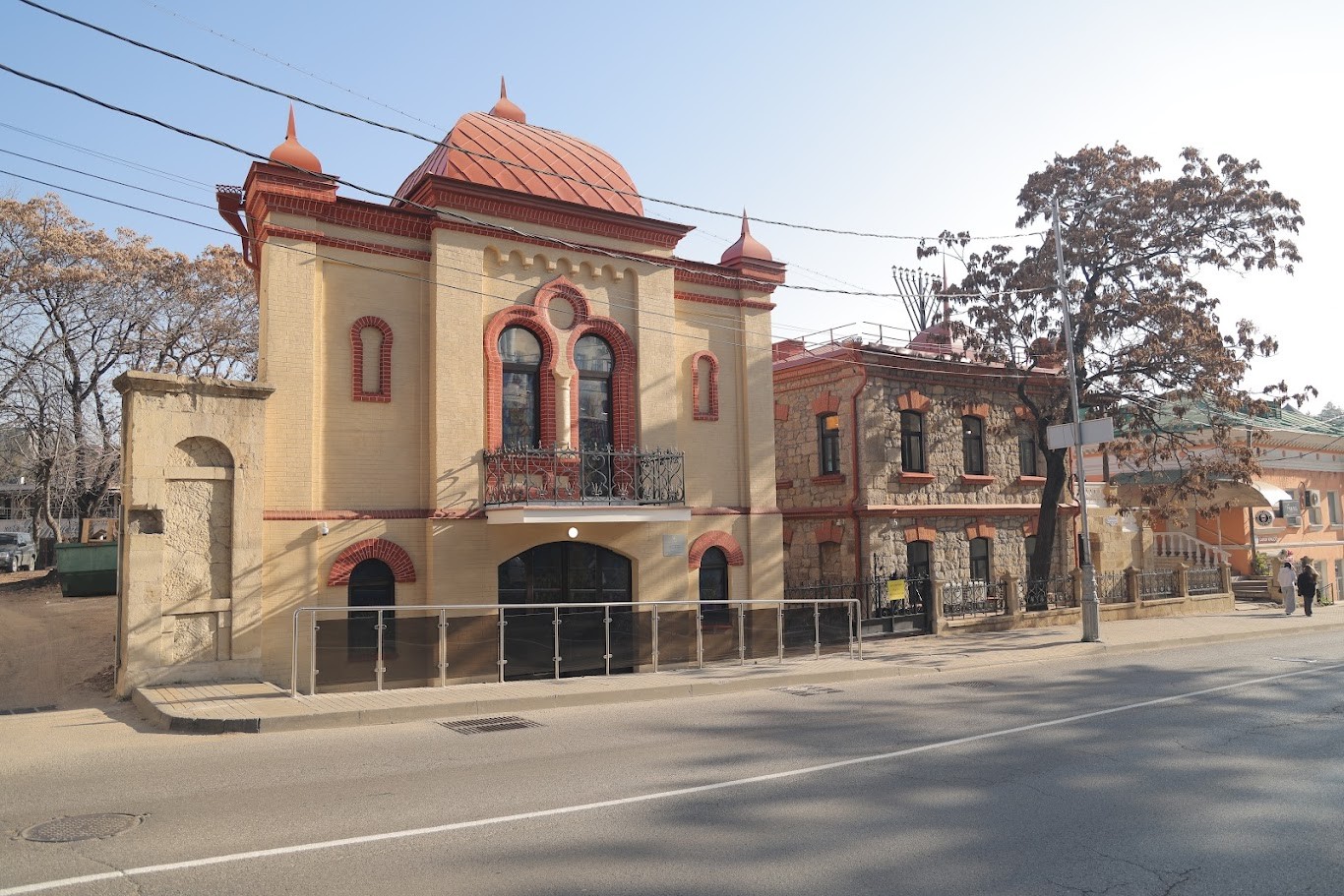
The Kislovodsk synagogue. Photo: Alex Sheriftrakhen / FJC
On a street in Kislovodsk, in the south of Russia, officers of the FSB, Russia's security service, stopped a young man with a backpack. It was Thursday, November 19, and by the FSB's account he was on his way to the city's synagogue. In the FSB's video a robot lifts the backpack. Inside, the FSB says, was a bomb he had built himself, three and a half kilograms packed with shrapnel, and he had watched the synagogue to find "the time of greatest public gathering." On camera the man, a Russian citizen born in 2004, says he "wanted to detonate it among worshippers in the city of Kislovodsk."
The synagogue he was walking toward was built at the end of the nineteenth century. In Soviet times it stopped serving the community, passed into private hands and fell into disrepair. In February 2019 two donors, Naum Babaev and Leonid Khanukaev, bought it back, and after six years of work, led by the city's Chabad shliach, it was dedicated again in November 2025, one year ago. The FSB announced the arrest this Tuesday. The shul's rabbi told reporters that there had been threats before, that security is being tightened, and that the life of the community goes on. Russia's chief rabbi, Rabbi Berel Lazar, thanked the FSB. The account of the plot is the FSB's own.
***
The day of the arrest was 9 Kislev, the birthday and the yahrzeit of the Mitteler Rebbe, who was freed from prison on 10 Kislev 5587 (1826). This Sunday is Yud-Tes Kislev, the day his father, the Alter Rebbe, was freed from prison in Petersburg in 5559 (1798). The Alter Rebbe wrote of that day: "when I was reading in the book of Tehillim, at the verse 'He redeemed my soul in peace' . . . I went out in peace, from the G-d of peace."
The verse ends with its reason: "כי ברבים היו עמדי, for the many were with me." On Motzei Yud-Tes Kislev 5752 the Rebbe went through what those words mean. King David said the verse of the victory in his wars. One of those wars was against his own son: Avshalom rose against him, won over the men of Israel and forced David to flee Jerusalem, and their armies met in the forest of Efraim. David's victory came, the Rebbe said, "in the merit of the many who were at his aid, praying for him, to the point that even Avshalom's men were praying for David's victory." The soldiers who faced him across the battlefield, the Yerushalmi says, were davening that he should win. In the Gemara, the one saying the verse is G-d. The Shechinah is in exile together with the Jewish people and is redeemed together with them, and G-d says: "Whoever engages in Torah and in acts of kindness and prays with the congregation, I count it as if he redeemed Me and My children from among the nations of the world." And ברבים, the many, begins with a minyan: wherever ten Jews gather, the Sages say, the Shechinah, G-d's presence, rests among them.
By the FSB's account, the man with the backpack studied the shul to learn when the most Jews would be inside it. He was looking for “the many.” The verse is about that same hour, when Jews stand together to daven. It says that David was saved because the many were with him, and the Gemara says that a Jew who davens with the congregation redeems G-d and His children from exile.
Yud-Tes Kislev is kept as the Rosh Hashanah of Chassidus: with the Alter Rebbe’s release its teachings began in earnest to spread outward, and that spreading, the Rebbe said, is what brings Moshiach. On Shabbos Vayishlach 5752 he asked about the date itself. The Jewish people are likened to the moon and count their months by it. Pesach and Sukkos fall on the fifteenth of the month, when the moon is full. Yud-Tes Kislev, the “festival of festivals,” falls in the second half, “when the moon is waning from day to day,” and Chanukah later still, when it disappears. Why do these days come as the light shrinks?
A full moon, the Rebbe answered, is still only receiving: all of its light comes from the sun. The moon is complete when it gives light of its own, as Yeshayahu promises: “the light of the moon shall become like the light of the sun.” The second half of the month leads there. The moon turns back toward the sun, “and the nearer it draws to the sun, the more its light lessens from day to day,” because it is nearing the sun itself, which is more than any light that comes out of it. To someone far off, the light is what shows and its source is hidden, so he calls the source darkness. Seen from the source, the Rebbe said, it is the reverse: “the radiance is darkness beside the essence, which is the ‘light.’” The moon is likened to the Jewish people and the sun to G-d, and when the two are one, “then the essence is revealed.”
So as the moon wanes a Jew counts upward, the seventeenth, the eighteenth, the nineteenth, and on Chanukah, when the moon is gone, he lights one more flame each night. The month’s name joins the two: כסלו is כס, covered, and לו, thirty-six, a number that stands for what is revealed. And nineteen is the sum of the letters hidden inside G-d’s name, the ones that show only when each of its four letters is spelled out in full.
This Shabbos the Torah reading is Vayishlach: "Yaakov sent messengers ahead to his brother Esav." On Shabbos Vayishlach 5752 the Rebbe explained what the messengers were sent to say. Yaakov had finished his own work, all of it "refined and repaired," "and the time has come to go together to the Redemption." Yaakov was ready and the world was not. The messengers came back to tell him that Esav was coming to meet him with four hundred men, and the Redemption, the Rebbe said, “did not come about in actual fact,” because the world itself was not yet ready for it. What has changed since is the work of all the generations, “and especially after the revelation of the teachings of Chassidus on Yud-Tes Kislev,” which each Rebbe carried further, until now the world is ready too. The Rebbe Rayatz, the Rebbe said, “announced and proclaimed that all the work has already been completed, even ‘the polishing of the buttons,’” the last touch on a uniform before the parade, “and everything is ready for the coming of Moshiach.”
The government in Petersburg arrested the Alter Rebbe in 1798. Last week, by its own account, Russia's security service stopped a man on his way to bomb a shul where the Alter Rebbe's teachings are learned.
For Yud-Tes Kislev the Rebbe asked for chassidishe farbrengens "in every place, in every country, in every city and in every neighborhood," large ones in the main centers and small ones everywhere else, each a center of its own that waits on no other, like the moon, the Rebbe said, when it has become like the sun. At every one of them Jews are to rouse each other to add in the three things the Sages find in the verse: Torah, davening with the congregation, and kindness to another Jew.
In Kislovodsk, the rabbi says, the life of the community goes on. That means a minyan this Shabbos in the shul that was lost through the Soviet years, at the hour the man with the backpack was looking for, and on Yud-Tes Kislev Jews sitting down together there and in every city. David said כי ברבים היו עמדי of the masses who davened for him. On Yud-Tes Kislev the masses are with every Jew who sits down at one of those tables, and the Rebbe closed that farbrengen by saying where the next one should be held, "even before the days of Chanukah": in the third Beis HaMikdash, at "the great farbrengen of the dedication of the third Beis HaMikdash, in the presence of all the Jewish people."
Sources
Tehillim 55:19, with Rashi; Berachos 8a; Yerushalmi Sotah 1:8
Shmuel II 15:13–14, 18:6
Bereishis 32:4, 32:7
Sefer HaSichos 5752, vol. 1, pp. 155–167: Shabbos Parshas Vayishlach, 16 Kislev 5752; pp. 168–173: Motzei Yud-Tes Kislev 5752
The Alter Rebbe's letter on his release, as quoted there
Yeshayahu 30:26
TASS, November 24, 2026; Times of Israel, November 24, 2026; JFeed, November 25, 2026; NEWSru.co.il, November 25, 2026